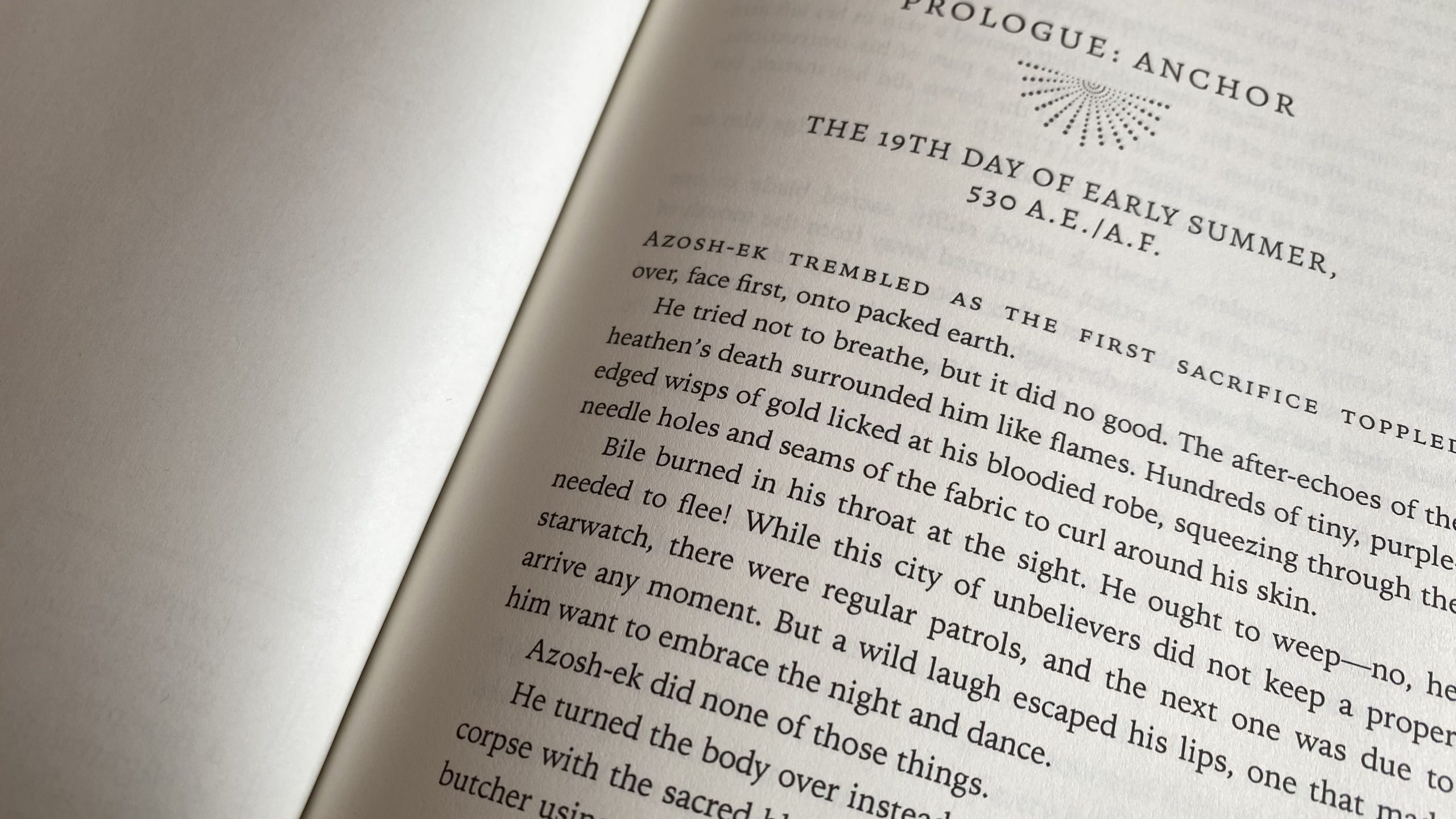
First lines, first paragraphs, and first impressions
What I learned while reworking the first chapters of my debut fantasy novel
This article was originally posted as a thread on Twitter on 29 July 2023. As of 2025, I permanently moved over to Bluesky and effective from 17 January 2026, I have deleted all of my Twitter posts due to the changed terms of service.
Some of my most popular threads, such as this one, I have preserved on my website (with minor edits, for accessibility and ease of reading) for posterity.
In July 2023, fellow author and SPFBO9 entrant Steven William Hannah embarked on a first chapter reading challenge: to read the opening chapter (including the prologue where applicable) of all 300 entrants to the contest. His efforts spurred many members of the SPFBO community on Twitter to do the same, encouraging many readers to TBR books they never otherwise would have picked up based on the cover and blurb.
This happened to collide with some other ongoing discourse on #booktwt at the same time.
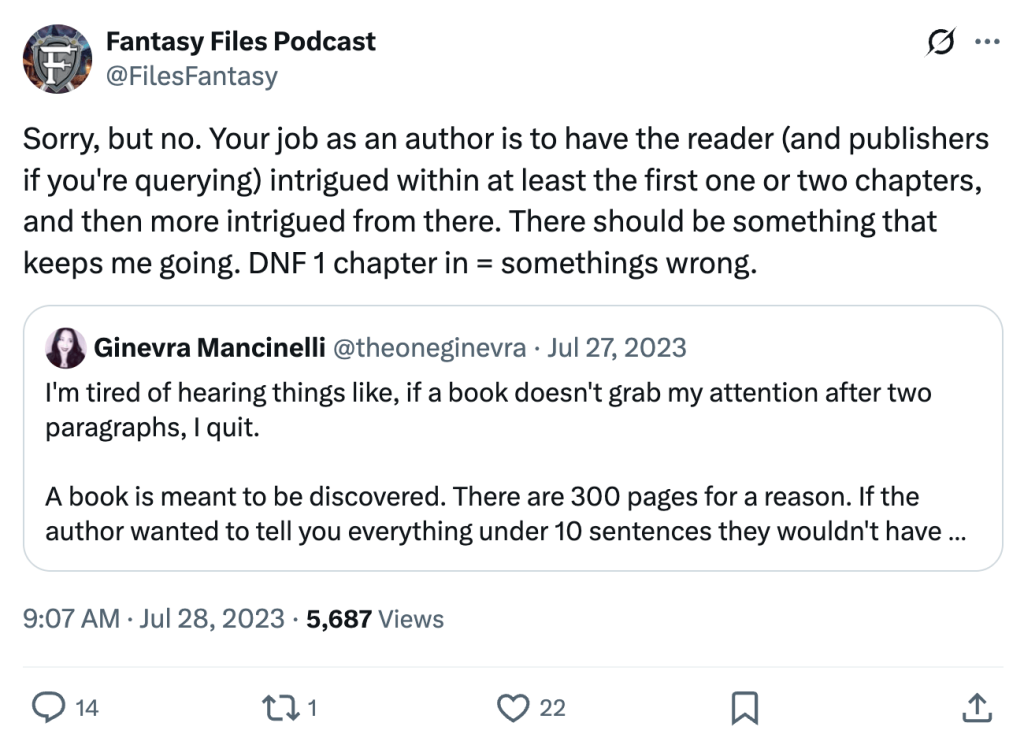
I had thoughts, which I had summed up at the time in the following reply:
Every sentence I write has one job & one job only: convincing the target reader for my book to read the next sentence.
If I succeed, they’ll read the whole book.
If they don’t, either I’ve made a misstep or they’re not my target reader.
(IMO, that’s the fairer way to put it.)
After sleeping on it for a day, it turned out that I had more to say. I have a soft spot for this thread because never had I ever imagined that one of my favorite authors, Janny Wurts, would see it, let alone quote tweet it:
I hope you’ll find it informative too. Enjoy!
—Delilah.
Following on from the current discourse re: first lines/paras/pages/chapters, I thought I would share a few things that I learned while working on mine.
Learning from songwriters and their lyrics
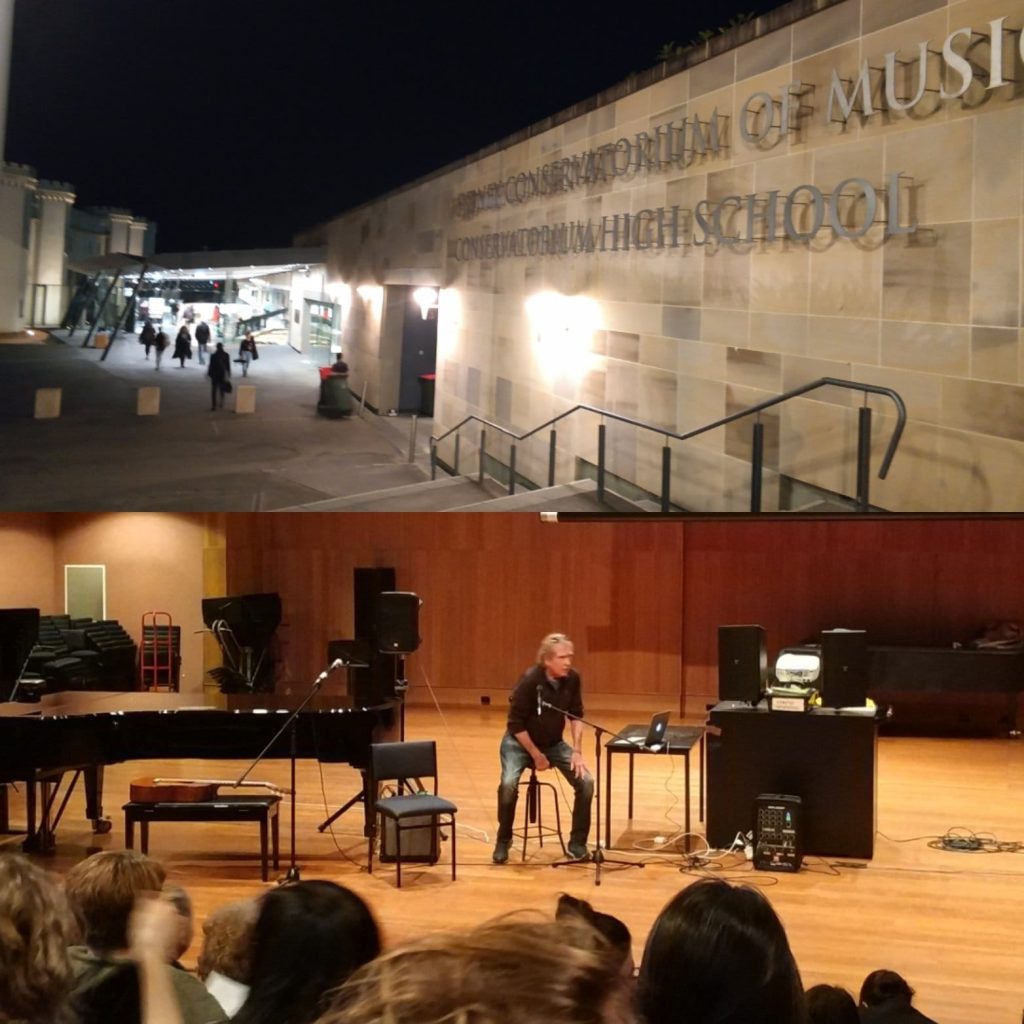
The best advice on first lines I ever got was in a songwriting workshop with Pat Pattison when he was visiting the Sydney Conservatorium of Music. Pat is a Berklee College professor, author of Writing Better Lyrics, and teacher to Grammy award winning songwriters like John Mayer.
In novels (especially fantasy), you have incredible luxury with word count.
Not so in songs.
Pat asked us how quickly we could establish character. A verse? A couplet? A line?
Beth Nielsen Chapman used TWO WORDS in “Child Again”:
Here’s the first verse from “Child Again”: a day in the life sketched in 40 words.
She's wheeled into the hallway
Till the sun moves down the floor
Little squares of daylight
Like a hundred times before
She's taken to the garden
For the later afternoon
Just before her dinner
They return her to her room
And those first two words—“She’s wheeled”—do so much heavy lifting in painting a vivid image of who this character is and what they’re doing because of how specific it is.
What I love about the lyrics of “Child Again” is how evocative they are.
We don’t need to be told this is set in a care facility because we can infer that from “wheeled”, “hallway”, and the “sun mov[ing] down the floor” in “little squares of daylight”.
The purpose of the first line and the first chapter
Establishing character & setting as vividly & quickly as possible is my goal for the first line of every scene.
In the prologue to my #SPFBO9 entry, Petition, I went for the basic: POV proper noun, strong verb, & a setting/sensory detail.
But that was not the first line I actually wrote. I didn’t even have a prologue originally; I added one in AFTER alpha and beta reader feedback because I wasn’t hitting the right tone, story, character, and plot promises with Chapter 1.
Petition originally opened right on Chapter 1. Here’s the side by side of the first two paragraphs: alpha draft versus the published version.
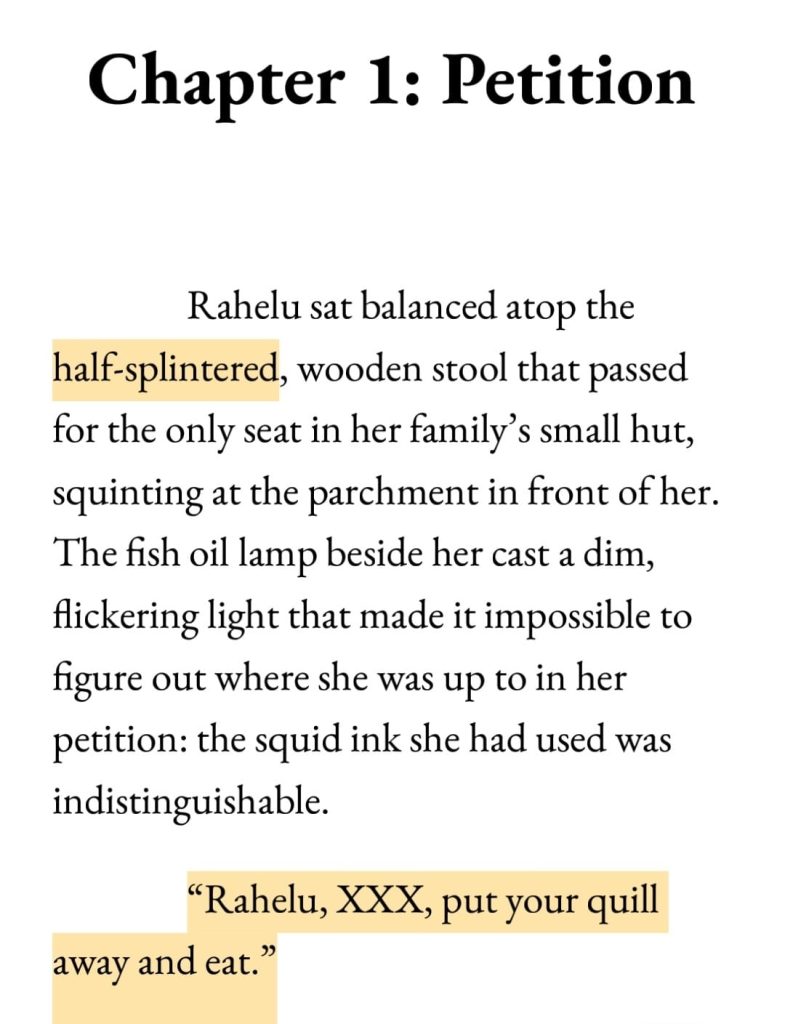
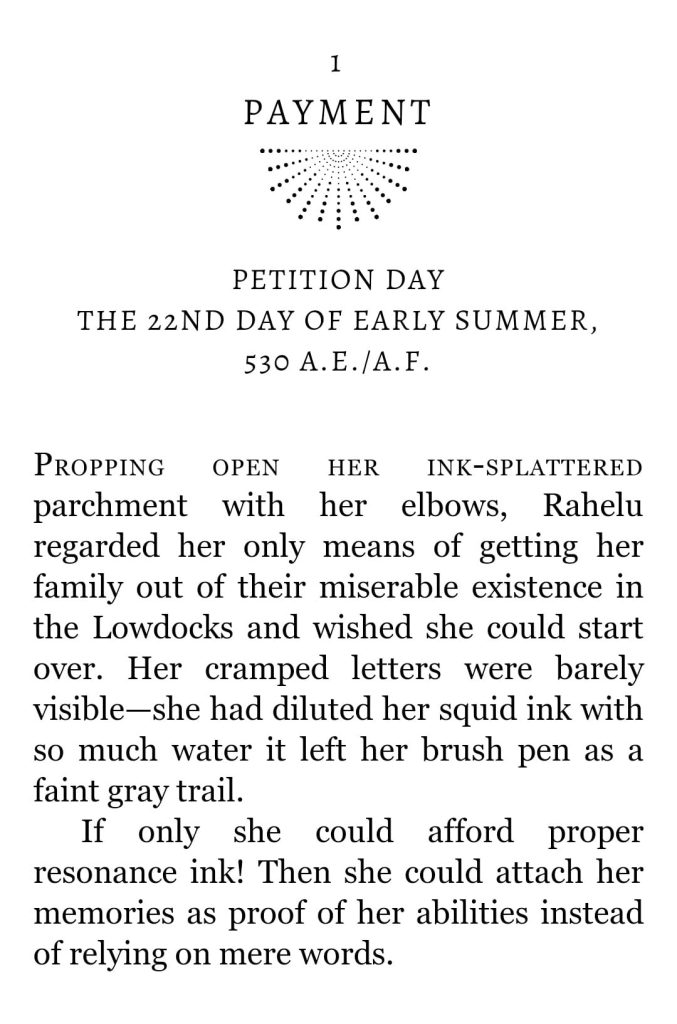
Same POV/scene/beat but the published version has more voice. I don’t love the slight clunkiness but never found a fix I liked. I did two rewrites for character and pacing, then trimmed 600 words in line edits & proofing. See the tracked changes of the full chapter from alpha draft to published version & why I made those changes here.
Here’s the side by side of the alpha draft versus the published opening to Chapter 2 of Petition.
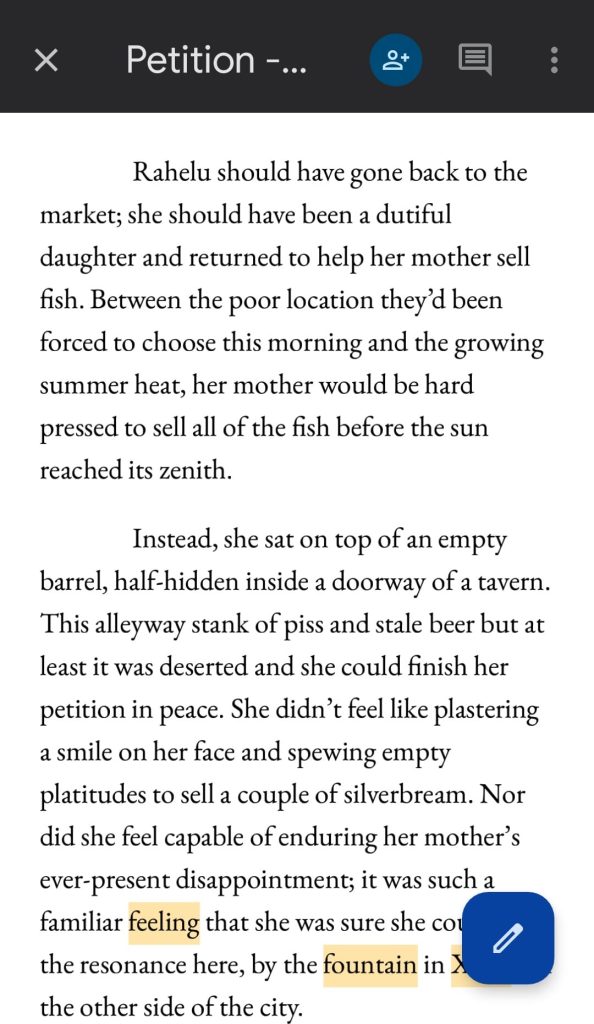
![Screenshot of the first lines in the published version of Chapter 2 of Petition by Delilah Waan.
Text reads:
Rahelu and her mother raced the light of the rising sun westward through the terraced streets of Ennuost Yrg. By some miracle of the Starfather, they didn’t slip once on the treacherous stair to the Temple district, and not a soul accosted them along the way to demand tribute.
Even so, they could not catch up to the leading edge of the eartharc rays sweeping across the city. By the time they staggered into Market Square on shaky legs, breath rasping in their lungs, the Isonn live fish haulers had already come and gone. They’d put the leaky barrel with her father’s latest catch in a cursed inconvenient spot—between the southern entry to the pavilion and the [excerpt ends here]](https://www.delilahwaan.com/wp-content/uploads/2026/01/firstlines_petition_ch2_published-606x1024.jpg)
They’re very different due to a huge structural rewrite from beta reader feedback. (More tracked changes & explanation here.)
Chapter 2 is the end of what I’d consider the opening of Petition.
By then, we’re ~8,000 words in and all the tone, story, character, and plot promises are established. If a reader isn’t hooked by then, they probably won’t be into the rest of the book.
Because I try to construct my openings as a reading experience of the book in miniature. The highs, the lows, the prose style, the themes—everything that might be divisive for readers, I try to fit in there, to signal audience so no one will feel clickbaited.
I don’t always succeed. There’s a subplot that doesn’t emerge until Chapter 9 that’s significant to the main character’s arc. The ending doesn’t land if you don’t buy it. But that’s where I run into problems with genre conventions/expectations.
Making promises and signaling genre expectations
One thing I learned is the term “romance”—as used by readers like me who read fantasy but not romance—has a very specific meaning in book marketing.
Short version: no HEA/HFN? Not romance! Don’t market as one.
So I don’t. I do everything I can to signal it is not a romance. No meet cute. None of the standard romance beats. No mention in the blurb or hint in the cover. But I do worry I will lose non-romance readers for not signaling the subplot upfront as a result.
Still, I hope by the time they’re ~38,500 words in, I’ll have established enough trust with them and delivered on a few payoffs that they’ll keep reading, for the characters and the rest of the plot even if they don’t enjoy that particular subplot.
The ending clearly works for some readers. The whole subplot is clearly cringe for some.
![Screenshot of Goodreads review. Text reads:
Her relationship with Lhorne was *chef's kiss* - I'm mostly a fantasy and romance reader and I understand that romance is probably not this book's primary genre, BUT the utter longing in the last scene they shared? [REDACTED] I'm going to need ten working days to recover 😭 [REDACTED] I just really loved this particular subplot okay?](https://www.delilahwaan.com/wp-content/uploads/2026/01/firstlines_petition_review1-865x1024.jpg)
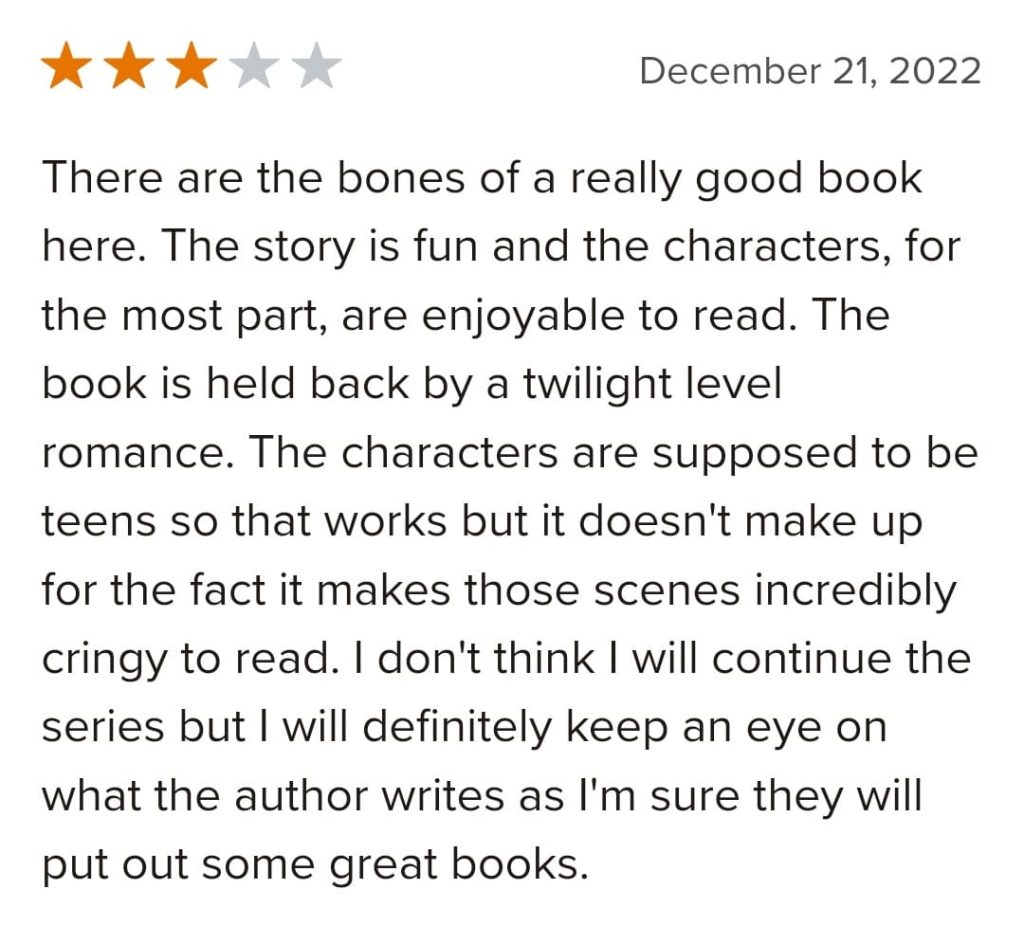
But every review is helpful in figuring out whether or not the book I delivered was the one they expected and if I missed signaling a promise somewhere.
What a reader’s DNF means for authors
Re: DNFs, for those who are just getting started and in Kindle Unlimited (KU)/KDP Select, it’s interesting to look at page reads.
Amazon KDP doesn’t give us anything as good as YouTube retention graphs, but when you only have the odd reader or two, you can see things. 👀
Petition was in KU on launch for 90 days & had a KENPC of 594.
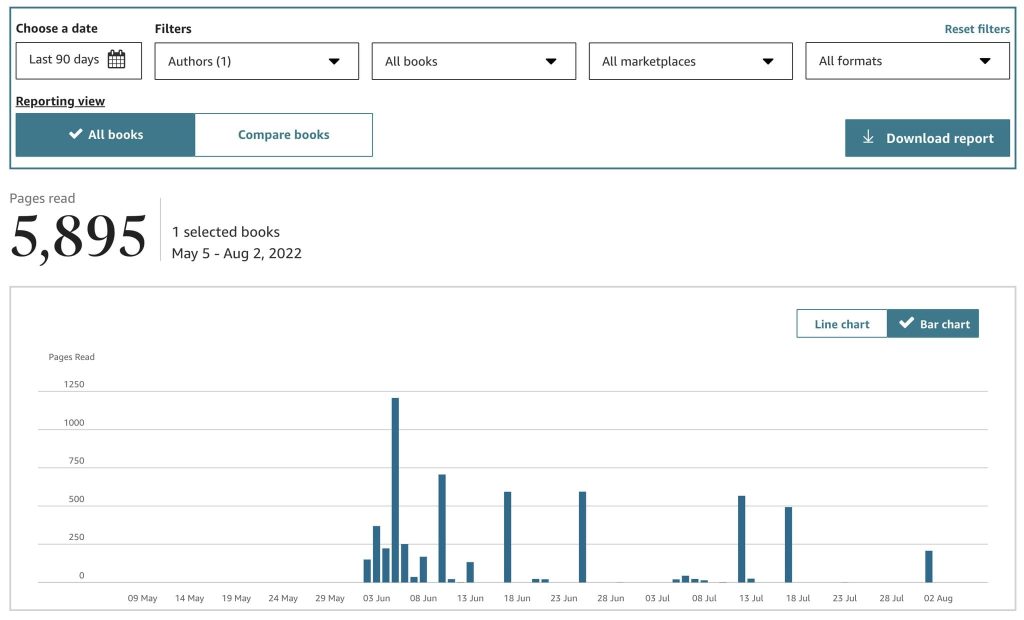
Full reads tended to be 592-593 pages depending on whether they read the back matter. And KU readers tended to binge the book in 1-2 sessions.
Good, because I tried to write a binge worthy book.
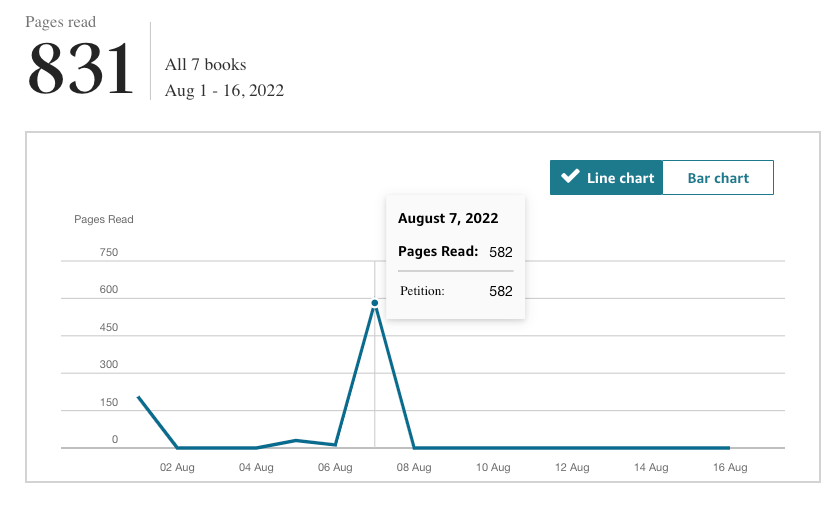
But that ending? Right around Kindle location 5528/5721 or 97% of the ebook or on page 409 of the paperback, there is a pivotal moment. A line that made my writing group scream things at me, like: “GODDAMNIT YOU MADE ME FEEL FEELINGS” and “I TRUSTED YOU” and
I don’t know what the corresponding KENPC is for that point in the book. KDP doesn’t tell me that information.
But when I look at this 582 pages read, I can only conclude somebody got to that exact moment and got so pissed they DNF’d 😂
A deep dive masterclass on writing good sentences
I think it shows that just because you’ve hooked a reader, you can’t assume they’ll keep sticking around. You’ve got to keep on winning them over, sentence after sentence, book after book.
The resource I’ve found most insightful in wrestling with the challenge of writing good sentences is Seth Dickinson’s article, Let’s Hurt Sentences:
I’m doing page proofs on THE TRAITOR BARU CORMORANT, my September debut. It’s a novel about sex, money, imperial power, colonial resistance, accounting, logistics, psychology, and the price of civilization. It’s a story about a young woman fighting to save her home and change the world. It’s made out of sentences.
I like quite a bit of it. Like any writer, I hate some of it. We can talk about the good stuff when the book comes out! Let’s talk about the sentences I’ve discovered I hate, the specific kind of sentence I loathe the most. Let’s figure out why they’re broken.
(Seth Dickinson is a brilliant author; check out his books & short stories if you haven’t already.)
Doing page proofs, I’ve been hitting a class of sentences that bother me a lot. They’re not clunkingly awful, but they leap out at me as missed opportunities. They’re uninhabited sentences: small, functional pieces of narration that don’t seem slanted by a certain character’s perspective. Every sentence should have a mission, and in the prose style I’m using here, every sentence should be a double agent, achieving a surface goal — say, moving a character through a door — and a deeper goal, hinting at emotion, motivation, past, future. Every sentence should have a voice, an owner. Ideally, the reader should know, at least subconsciously, who that owner is.
It’s an eye opening dissection of prose. Look at how Dickinson thinks about what to emphasize versus what to gloss over.
What is the purpose of each sentence? What reaction do you want the reader to have after reading the sentence?
But these sentences I keep meeting are the faceless stormtroopers of prose style. They just sit there connecting interesting things. That’s a waste! Every word should be interesting! Every stormtrooper should get a chance to bang her head on a door or curse creatively.
Let’s grab one. Baru Cormorant watches a woman come into her office.
“Aminata slipped past Muire Lo, who closed the great door with a firm click, and presented herself at attention with a frame of palimpsest tucked under her arm.”
Things Dickinson considers:
What does the sentence reveal about the POV character & the sentence’s subject?
How does it sound when read aloud?
What kind of rhythm & prosody is established with word/punctuation choice, construction, & line breaks?
How could we fix it? We could just radically simplify it. Aminata snapped to attention. We lose Muire Lo, the palimpsest, and a bit of spatial information. But maybe none of that’s important. Aminata can hit her next dialog beat and we can move on with the scene. This is a simple sentence that builds energy, because the reader doesn’t need to spend time figuring it out.
Look at how Dickinson changes EVERYTHING about the way the moment reads just by changing one line of the prose.
How could we play it? Exploring:
Aminata left her papers with Muire Lo and stepped up to salute.
Aminata left Muire Lo to fumble with her papers. Her straight-backed salute made Baru want to apologize for the state of everything, the accounts, the office, the way they’d left matters on Taranoke.
Aminata snapped to attention. Baru liked the salute so much she almost replied in kind. Muire Lo, still fumbling with Aminata’s papers, scurried out of the way.
Aminata smiled slantwise at Muire Lo, who blushed, and slipped past him to salute and set herself at attention. Baru cleared her throat and wished she could look so damn upright.
Aminata came down the length of the office, past Muire Lo and the plotting table and the wine, to snap a perfect salute. Baru remembered her coming down the back hall at school, coming across the dueling floor, and swallowed.
It’s absolutely fascinating how the subtext and emphasis shifts in these different iterations.
Seriously. Read the whole article. (And read Baru.)
Here’s the version Dickinson ended up publishing for that moment.
“Your Excellence.” Aminata came down to the office to salute and set herself at attention. Baru cleared her throat and wished she could look so damn upright. She must have stopped and dusted her uniform, or had a spare brought off the ship. She looked immaculate. The years had kept her taller than Baru, and her duties had kept her graceful and strong, as forthright and ready as a good javelin. There were many reasons Baru had avoided her on Lapetiare.
I personally like the second variant explored the most at the sentence level. But the final version fits the scene and the story best.
Finally AP Canavan has some great breakdowns on writing on YouTube. I’m going to highlight two videos but definitely check out the whole channel.
First, on the importance of authorial intention, audience, and economy in writing:
Second, a brilliant look at a passage by one of the GOATs in epic fantasy, Janny Wurts:
There’s so much going on in this passage. It’s wonderful. If you haven’t tried any Janny Wurts yet, you definitely should!
Conclusion
The output of good writing looks simple but the process of getting there is hard. Sometimes I feel like a character who just did magic. I have no idea how I did what I did or how to (or if I can) do it again.
But writing is a craft and you can get better at it.
The first lines of the beta draft of Supplicant, the sequel to Petition, are not where I’d like them to be.
![Screenshot from the beta draft of the prologue for Supplicant by Delilah Waan.
Text reads:
Prologue: Toll
The 3rd day of truesummer, 530 A.E./A.F.
Uvesht-mo faltered in the midst of his deepnight prayers.
The stars were ringing.
A chime, a gong, whose round tones were so deep they could not be heard, could not be perceived, except as a thrumming in his bones that shook the very substance of his being until his heart felt like it would burst. Lit sticks of incense fell from his limp fingers to land on the cave floor, their scent smothered by the flurry of damp sand kicked up in his wake.
Outside the sea cave, Uvesht-m
the Starfather's gaze and wept. Tears of joy and [excerpt ends here]](https://www.delilahwaan.com/wp-content/uploads/2026/01/firstlines_supplicant_beta_prologue-600x1024.jpg)
![Screenshot from the beta draft of the first chapter for Supplicant by Delilah Waan.
Text reads:
Chapter 1: Departure
The 10th day of truesummer, 530 A.E./A.F.
Rahelu leaned on the Winged Arrow's taffrail, watching the shadowed city of Ennuost Yrg shrink from view. They passed by the Isonn fishing fleet as they sailed eastward into the rising sun. At this distance, the individual boats scattered across the calm waters on the south side of the Kuath bay were as minuscule as grains of rice.
Still, she scanned each one: straining her eyes to try and pick out the patched gray sail and plodding lines of her parents' sloop from its fellows. A swift, sharp motion in the eartharc light drew her gaze to one of the smaller vessels with two figures aboard. She [excerpt ends here]](https://www.delilahwaan.com/wp-content/uploads/2026/01/firstlines_supplicant_beta_ch1-600x1024.jpg)
But there’s still a long way to publication so 🤞 I’ll figure out something better by then. For now, you can check out Petition.
POSTSCRIPT (17 January 2026): Supplicant was published in December 2024. The opening of the prologue remained the same. The first chapter, however, underwent considerable changes, and the opening lines now read as follows:
Rahelu pelted through the Lowdocks.
Though the sun had yet to crest the horizon, the bare stones of the wet market were already slimed with fish guts and seafowl offal (and gods only knew what else) squishing between her toes. A flock of gulls shrilled at her as she tore through their feasting and startled them into flight.
She cursed.
Why were she and Lhorne both such short-sighted, silly, sentimental fools?
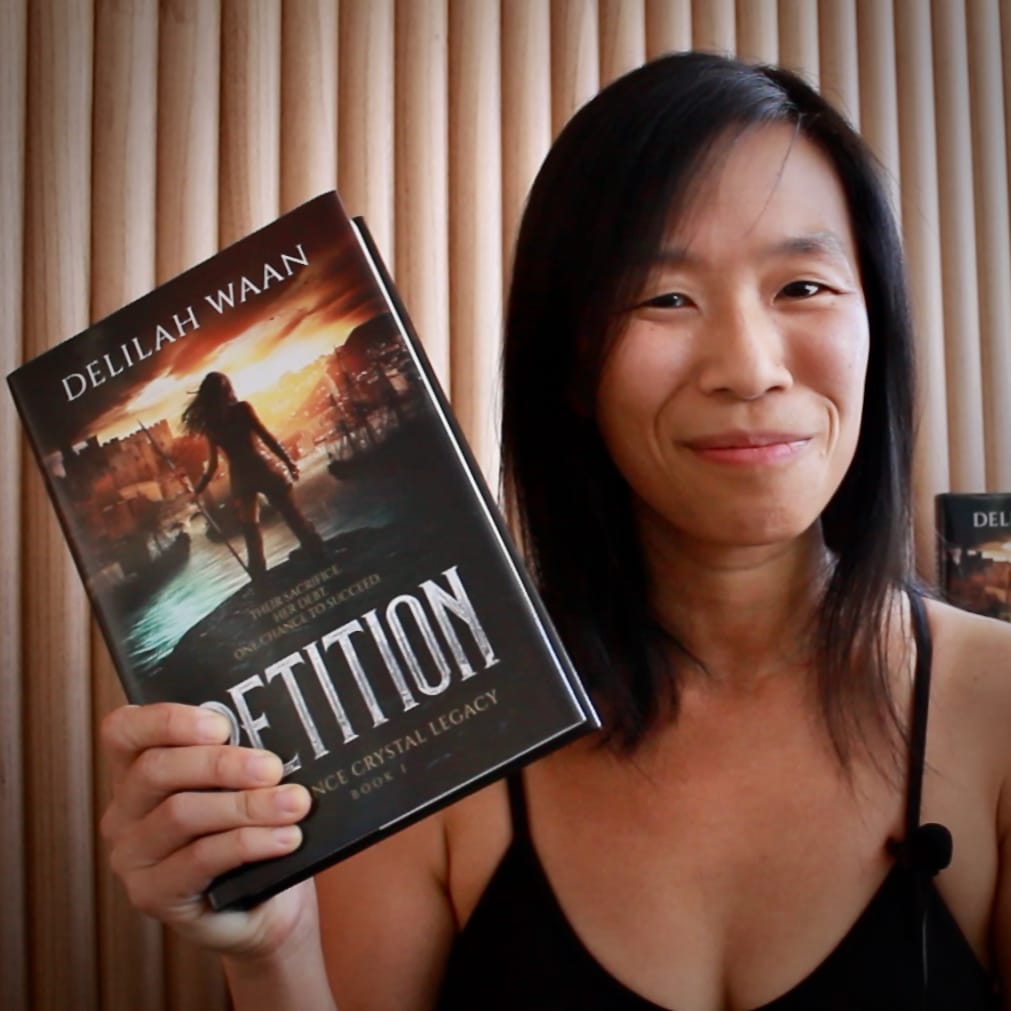
Delilah Waan had nothing to add to “magic school” so she wrote “fantasy job interviews” instead.
Petition is her award-winning debut fantasy novel about an angry Asian daughter of impoverished immigrants fighting privileged rich kids in a ruthless job hunt tournament.
Follow @delilahwaan.bsky.social for more of her thoughts on books and publishing.